

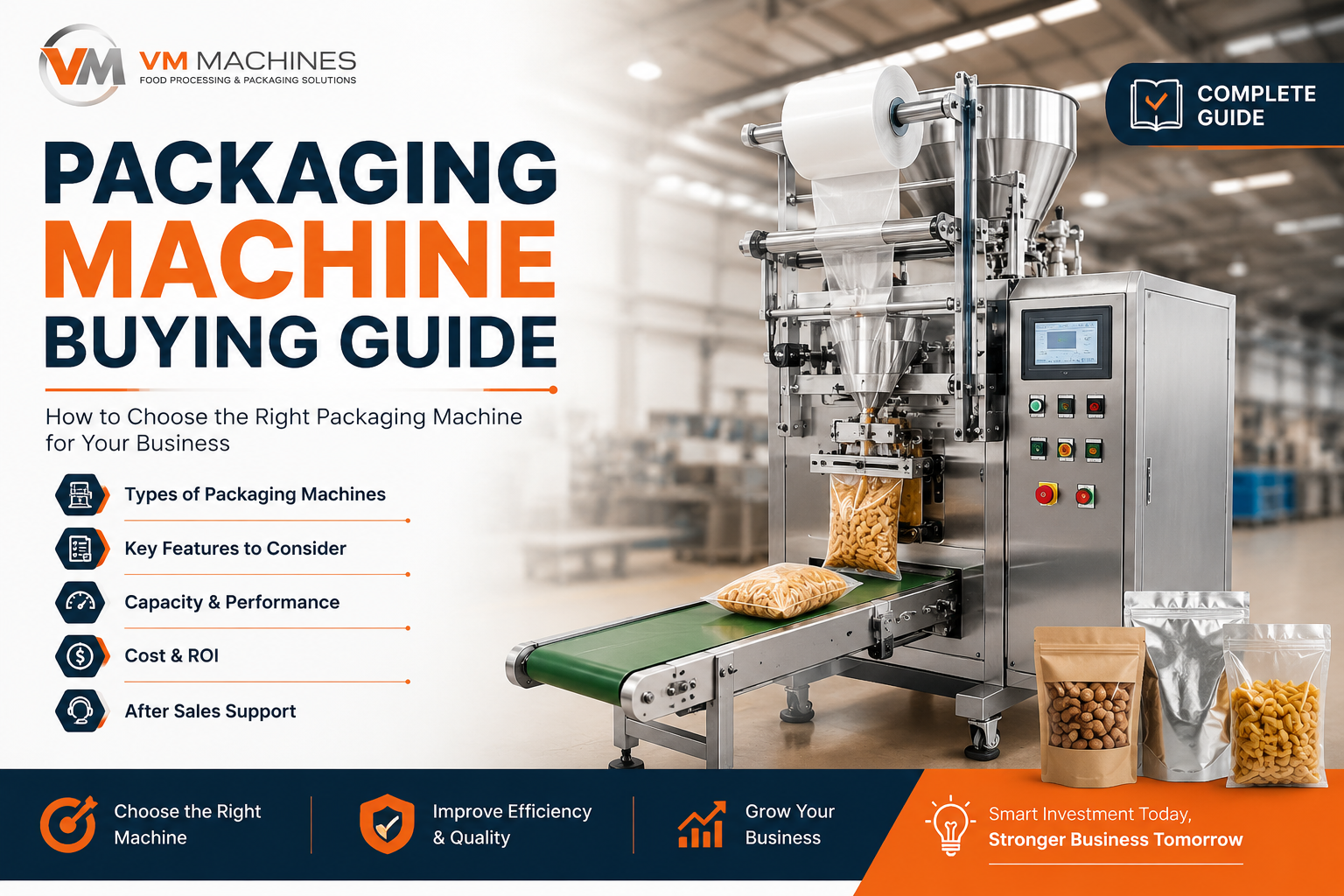
The Ultimate Packaging Machine Buying Guide: How to Choose the Right Equipment
In the food processing industry, your packaging is just as important as the product inside it. It protects against moisture, extends shelf life, ensures exact portion control, and acts as your brand’s billboard on the retail shelf.
However, transitioning from manual packing to automated packaging can be a daunting process. With hundreds of machine types, varying production speeds, and complex pneumatic systems, making the wrong choice can lead to massive product wastage, endless downtime, and lost capital.
As industry experts at VM Food Processing & Packaging Machines, we have helped countless businesses scale their operations. In this comprehensive buying guide, we break down everything you need to know before investing in a commercial packaging machine.
1. Understand Your Product’s Physical Characteristics
The type of product you are packing dictates the feeding and weighing mechanism of the machine. Never buy a “one-size-fits-all” machine without testing your specific product first.
- Free-Flowing Granules & Snacks: Products like Kurkure, namkeen, rice, and whole pulses require Multi-Head Weighers or Volumetric Cup Fillers to prevent crushing and ensure high-speed accuracy.
- Powders (Sticky or Dusty): Spices, flour (atta), and milk powder require Auger Fillers. An auger uses a rotating screw to push exact volumes of powder into the pouch without creating a dust cloud.
- Liquids & Pastes: Edible oils, sauces, and ginger-garlic pastes need specialized Piston Fillers or liquid pump dispensers capable of handling varying viscosities.
2. Choose the Right Machine Type
Packaging machines generally fall into three main categories based on automation and output capacity:
Semi-Automatic Weigh Fillers & Band Sealers
Best for: Startups and small-scale operations (10-20 pouches per minute).
How it works: The machine weighs and dispenses the product into a pre-made pouch held by an operator. The operator then feeds the pouch into a continuous band sealer. It requires low capital but higher labor.
Collar Type Form Fill Seal (FFS) Machines
Best for: Medium to large factories packing snacks, grains, or powders (30-80 pouches per minute).
How it works: This is a fully automated beast. It takes a flat roll of printed packaging film, forms it into a tube (using a metal collar), fills the exact weight of the product, seals it, and cuts it—all in one fluid motion.
Multi-Head Weigher (VFFS) Systems
Best for: High-speed snack lines requiring extreme weight accuracy (up to 120+ pouches per minute).
How it works: Uses a computerized network of 10 to 14 weighing buckets. The computer instantly calculates which combination of buckets equals the exact target weight (e.g., exactly 50g of potato chips) and drops them into the FFS machine below. It virtually eliminates “giveaway” overfilling.
3. Key Specifications to Evaluate
When reviewing quotations from machinery manufacturers, pay close attention to these metrics:
- Pouches Per Minute (PPM): This defines your throughput. Calculate your daily production target and ensure the machine’s comfortable cruising speed (not just its maximum theoretical speed) meets your needs.
- Weight Accuracy: A machine that overfills by just 2 grams per pouch can cost you lakhs of rupees in lost product over a year. Insist on accuracy tolerances of ±1% or better.
- Changeover Time: If you pack 50g, 100g, and 500g pouches on the same machine, how long does it take to change the forming collar and film roll? Look for tool-less changeover features.
- Build Material: Ensure all contact parts (where the food touches the machine) are made of SS 304 or SS 316 Food-Grade Stainless Steel to comply with FSSAI standards.
4. Don’t Forget the Hidden Utility Costs
Many first-time buyers deplete their budget on the packaging machine, only to realize they are missing the critical support utilities required to run it:
- Air Compressor: Pneumatic FFS machines require a heavy-duty industrial air compressor to drive the sealing jaws and cutting knives.
- Nitrogen Generator/Cylinders: If you are packing fried snacks (like namkeen or chips), you must flush the pouch with nitrogen gas to displace oxygen. This prevents the oil from turning rancid and keeps the snack crispy for 6+ months.
- Batch Coding Printer: You will need an integrated Thermal Transfer Overprinter (TTO) or inkjet coder to print the MRP, manufacturing date, and batch number directly on the film roll.
5. Why After-Sales Service is the Dealbreaker
A packaging machine is a high-speed mechanical system with sensors, PLCs, and pneumatic valves. Eventually, it will require calibration, wear-and-tear part replacements (like heater coils or Teflon tapes), and software troubleshooting.
Buying cheap, imported machines with no local service footprint often results in days of factory downtime while waiting for a single spare part. Always partner with an Indian manufacturer who provides robust warranties, on-site installation, staff training, and readily available spares.
Ready to Automate Your Packaging?
At VM Food Processing & Packaging Machines, we don’t just sell equipment; we engineer complete packaging solutions tailored to your product, pouch size, and budget.
Whether you need a simple band sealer or a fully integrated 14-head multi-weigher FFS line, our team is ready to assist you in making the most profitable choice for your factory.
