

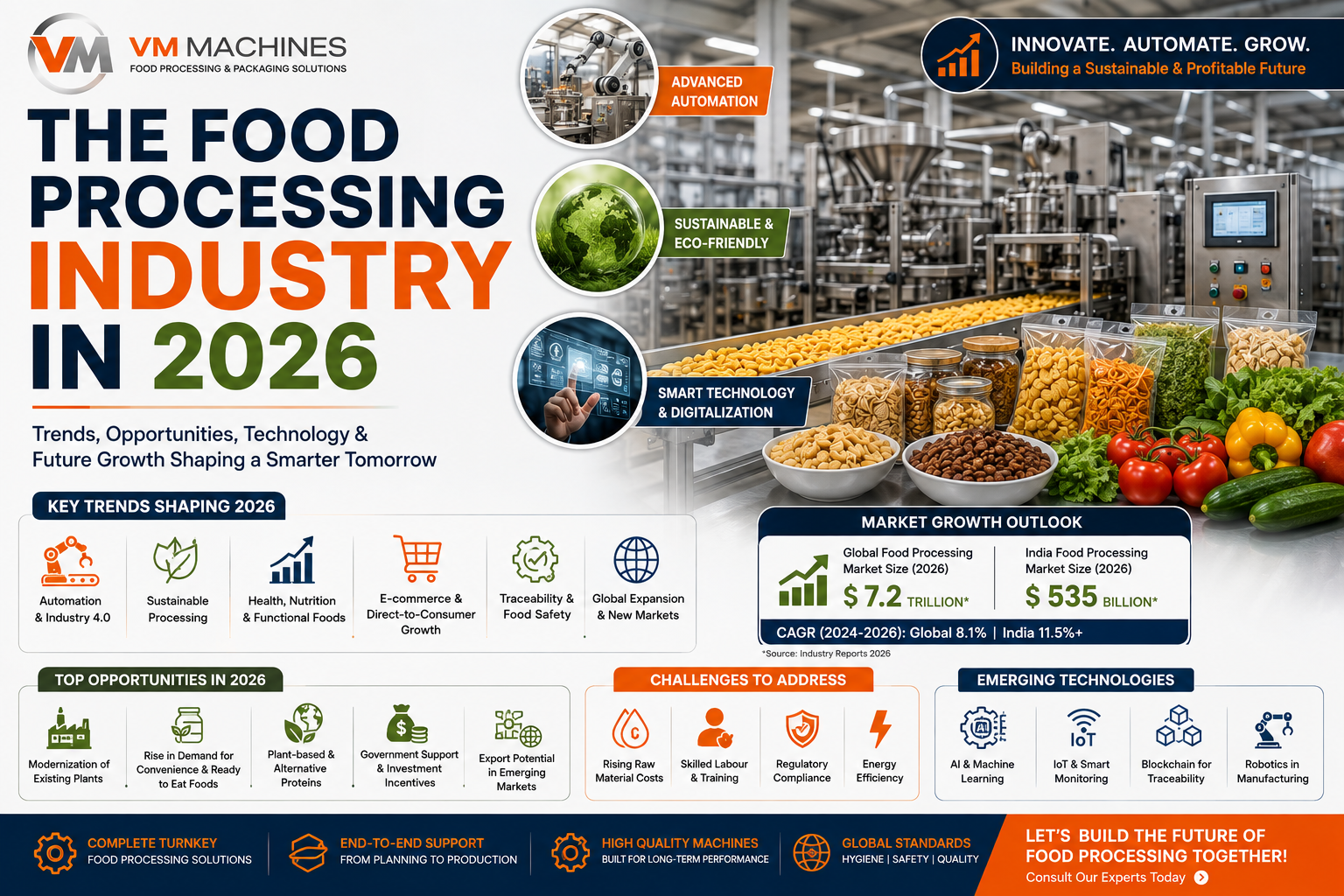
Innovations, Trends, and Machinery Driving the Future
The food processing industry stands at the crossroads of tradition and technology, transforming raw ingredients into the safe, convenient, and diverse products that feed the world. As we enter 2025, the sector is navigating a landscape of rapid innovation, economic shifts, and consumer demands for sustainability and personalization. With global market projections soaring—expected to reach $857 billion by year’s end—this industry is not just processing food; it’s redefining how we eat.
In this article, we’ll explore the latest updates, emerging trends, and groundbreaking machinery that’s propelling the food processing world forward. Market Outlook: Growth Amid Uncertainty The food processing sector is poised for robust expansion in 2025, despite geopolitical and economic headwinds. A majority of food and beverage manufacturers anticipate a 20% increase in throughput, fueled by rising global demand for processed goods.
However, this optimism is tempered by caution: with President Trump’s return to the White House, industry leaders are bracing for a “wild ride” of policy changes, trade tariffs, and supply chain disruptions.
Food prices are another wildcard, forecasted to rise faster than the historical average, driven by inflation in commodities and logistics costs.
On a brighter note, demand for processed fruits and vegetables is surging at an annual rate of 5.5%, reflecting consumer shifts toward healthier, convenient options.
The machinery market itself is booming, with projections for a 6.1% CAGR through 2029, reaching an additional $21.7 billion in value. Small manufacturers, in particular, are adapting to these dynamics by focusing on agility and tech adoption to stay competitive. Key Trends Reshaping the Food Processing Landscape2025 is a year of transformation, with technology and sustainability at the forefront. Drawing from expert analyses, here are some pivotal trends:
- Artificial Intelligence Revolutionizing Operations
AI is optimizing everything from crop forecasting to logistics, slashing energy use by 40% and CO₂ emissions by 35%. In manufacturing, it enables predictive maintenance and real-time quality adjustments, reducing waste and boosting efficiency by 10-20%. - Robotics and Automation Everywhere
From vineyard robots to factory floors, automation handles sorting, packaging, and even 3D-printed custom parts, cutting downtime and enhancing precision. Expect collaborative robots (cobots) to dominate, improving throughput by 15% while freeing workers for higher-value tasks. - Sustainability as a Core Imperative
A 360° approach to sustainability integrates lifecycle assessments, with companies like PepsiCo aiming for zero-emission plants. This trend could lower operational costs by 15-25% through energy-efficient processes and circular economy practices. - Transparency and Traceability
Blockchain and smart labels ensure full visibility from farm to fork, reducing fraud and enabling instant recalls—slashing response times from days to seconds. - Rise of Alternative Proteins and Personalization
Precision fermentation and novel ingredients like algae-based proteins are meeting demand for sustainable, ethical foods. Meanwhile, AI-driven customization allows small-batch production tailored to individual diets, commanding premium pricing. - Data Analytics and IoT for Real-Time Insights
IoT sensors monitor conditions in real-time, cutting downtime by 20% and enabling remote management. - Enhanced Food Safety Standards
Advanced detection tech and compliance tools are minimizing recalls, with hygienic designs reducing cleaning times by 50%. Globalization and Consumer Shifts Emerging markets and e-commerce are disrupting retail, pushing processors toward flexible, sustainable supply chains. - Smart Packaging and Logistics
Edible, sensor-embedded packaging extends shelf life while connecting consumers to product stories via QR codes.These trends underscore a shift toward resilient, tech-enabled operations that prioritize health, planet, and profitability.Cutting-Edge Machinery: The Machines Powering 2025Innovation in equipment is the engine of this evolution. Here’s a spotlight on standout machines and technologies making waves:
|
Innovation
|
Key Features
|
Benefits
|
Examples/Applications
|
|---|---|---|---|
|
High-Pressure Processing (HPP) Systems
|
Non-thermal pathogen inactivation using extreme pressure; preserves nutrients without heat.
|
Extends shelf life 3x; reduces preservatives; lowers energy use. Global market to hit $1.5B. foodtecpro.com
|
Juices, ready-to-eat meals, deli meats. |
|
AI-Driven Robotic Automation
|
Cobots with vision-guided sorting, precise slicing, and packaging; integrates ML for adaptive learning.
|
Cuts labor costs 25%; boosts throughput 15%; minimizes contamination.
|
Meat/dairy slicing, bakery handling. |
|
Advanced Vision Inspection Systems
|
High-res cameras + AI for 200+ inspections/sec; detects defects, contaminants, and labeling errors.
|
99% accuracy vs. 80% manual; reduces waste and recalls. Market to $4.2B. foodtecpro.com
|
Sorting produce, quality checks in packaging lines. |
|
Next-Gen Freezing (IQF) Tech
|
Cryogenic and vacuum methods prevent ice crystal damage; rapid, uniform freezing.
|
Maintains texture, nutrition; extends storage without additives.
|
Frozen fruits, seafood, ready meals. |
|
3D Food Printing Machines
|
Layer-by-layer extrusion for custom structures; uses bio-inks from plant proteins.
|
Enables personalization; reduces waste in prototyping.
|
Plant-based meats, decorative choco
|
|
Modular Extrusion Systems
|
Adjustable for texture/composition; high-efficiency for diverse outputs.
|
Versatile for cereals to proteins; shortens production time.
|
Breakfast cereals, alternative proteins. |
|
IoT-Enabled Smart Sensors
|
Cloud-connected for temp/humidity monitoring; predictive analytics.
|
20% less downtime; 15% energy savings; full traceability.
|
Cold chain logistics, fermentation vats. |
|
Automated Dosing and Mixing
|
Precision ingredient delivery with AI forecasting; emulsification tech.
|
Uniform products; cuts errors and overproduction.
|
Sauces, doughs, beverages. |
|
UV Sterilization Units
|
Chemical-free UV light for pasteurization; integrated with HPP.
|
Preserves flavor; enhances safety without heat damage.
|
Dairy, juices. |
|
Blockchain-Integrated Traceability Tools
|
Secure ledgers for ingredient tracking; QR-enabled.
|
Instant recalls; builds trust; 35% CAGR in adoption.
|
Supply chain from farm to shelf. |
These machines aren’t just tools—they’re smart systems fostering efficiency, safety, and eco-friendliness.
The result? A more resilient sector that’s as nourishing for the planet as it is for consumers. What trends are you watching in food processing? Share in the comments below! Sources: Compiled from industry reports and analyses as of November 2025. For more on equipment at events like PACK EXPO 2025, check out the latest showcases
